Hello, this is the first entry in our new series on the amendments. We are beginning with the last one and going backward until we reach the first. We are doing it this way because it is often the amendments we know the least which have the greatest influence on our lives. For example, Amendment 16 gives Congress the right to collect income tax. That has a HUGE influence on people’s lives, and I bet you didn’t know it was an amendment that gave Congress that power. So, we at American Storytellers thought we could provide a quick introduction to each amendment. So here we are, starting at the Omega and moving towards Alpha. Buckle up, folks, it’s going to be a backward ride!
The Amendment
The 27th Amendment was ratified in 1992 even though it was proposed in 1789. That’s a waiting period of over 2 centuries. Why did it take so long? I mean when you look at the text, it seems like a no brainer.
“No law, varying the compensation for the services of Senators and Representatives, shall take effect until an election of Representatives shall have intervened.”
In plain language it means that if our representatives vote themselves a pay raise, before they can collect that raise the voters get the chance to vote their greedy butts out of office.
It turns out that even in the early days of our Republic, citizens were on guard against greedy selfish men who would, to quote FDR, “clip the wings of Liberty to feather their own nests.” The issue of how much federal elected officials should get paid has been HOTLY debated from the beginning. At one point many thought elected officials should not be paid anything. That idea died quickly as you can imagine. After all, that would mean only the independently wealthy could afford to run for office. Even the elitist founding fathers knew that wouldn’t fly.

That issue and many others nearly defeated the Constitution before it was even ratified. To get the reluctant states on board, James Madison promised to address most of their concerns through the amendment process. In the first session of Congress, Madison proposed an enormous list of amendments. This Congressional salary amendment was #3 on his list. Maryland & North Carolina ratified it at once. South Carolina & Delaware ratified it the next year. The year after that (1791), Vermont & Virginia ratified it. Kentucky was the last state to ratify it in those early days. Kentuckians ratified it in June of 1792 – three years after Madison proposed it. That was it. No other state touched it for eight decades. The proposed amendment fell 3 short of the necessary 3/4th of the currently existing states to become part of the Constitution. However, and this is key, the Constitution doesn’t put a time limit on the ratification process. So, the amendment never died. It just sat out there in the ether, in limbo, and just waited.
Don’t Mess with Ohio
Now we come to the Great Salary Grab of 1873. This, in my opinion, is one of the great Doh! moments of American history. To really grok how Doh! this moment was, we need a little background.
First thing you need to know is that salaries for federal officials & employees had not been raised in a VERY long time. The President hadn’t gotten a raise since … ever. That’s right. President Grant was making the same amount as President Washington even though it was eighty-four years later. Considering that he had just won the Civil War for us, Pres. Grant deserved a raise. Pay was even worse for the six thousand office staff who worked for the executive branch. Male clerks were paid between $1,200 – $3,000 a year depending on seniority. Female clerks were paid $900 a year regardless of experience, education or workload. Even in those days, that pay was considered laughably low. It was universally agreed that federal employees & officials need more pay, but there were other issues to consider. At the exact same time federal officials were crafting the law to raise their salaries, the US economy got hit with a huge financial panic.
Rabbit Hole: A financial panic is a dramatic economic downturn. Somewhere in the late 19th or early 20th century economists decided that the term panic was too harsh and upset people. So, they changed the term to depression which was seen as a calming word. Afterall a footprint is a depression. Nothing to worry your pretty, little head about, it is just a depression. Then came the Great Depression and nobody liked that term anymore, so now we call the same thing a recession. Nobody likes that word either. We will see what they come up with next.
Anyway, in 1873 a major bank, Jay Cooke & Co., failed. It failed spectacularly, like the-space-shuttle-exploding spectacularly. It was bad, and it brought the whole economy down with it. Other banks failed, businesses went bankrupt, and unemployment skyrocketed! It turned out to be one of the longest panics in the US history, but, of course, no one knew that yet. They did know that they were struggling financially and so were their neighbors. Not the greatest time to hear that your congressman, senators and president all just doubled their own pay.
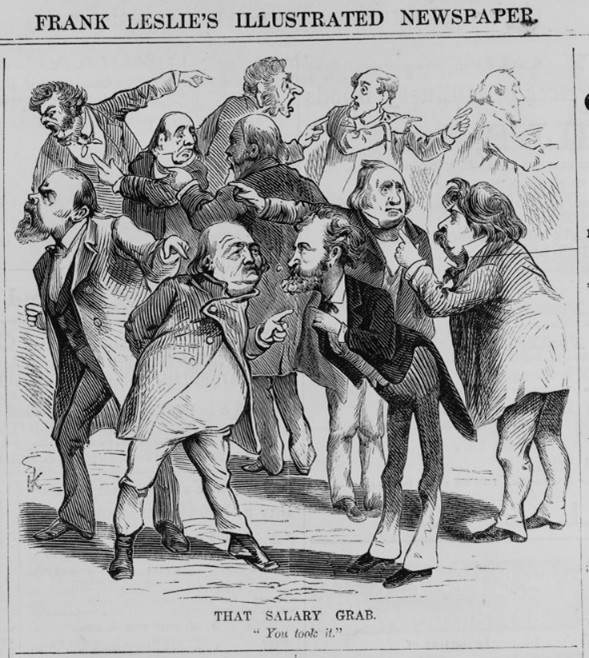
As bad as the pay raise was, it was the cash bonus that really infuriated most people. You see, the legislators made the pay raise retroactive to the last election two years earlier. That gave the congressmen and senators a cash bonus equal to two years of salary at their new pay rate. How do you like that idea? Wouldn’t you like to be able to vote yourself a cash bonus equal to 2 years of salary whenever you felt like it? I know I would. And, do you remember a few paragraphs up where I mentioned what clerks got paid? A pay increase probably would have helped them. Guess what? The politicians did not share their bonuses with any other executive branch employees. The rich senators got pay raises, but their janitors didn’t. Typical. What I find funniest about this whole saga is that the congressmen and senators were honestly gobsmacked at the public reaction. They truly believed that they were unquestionably entitled to the bonus and were stunned at the negative reaction they got from the public and newspapers around the country.
But wait, there’s more! Another factor in the Salary Grab scandal was the Credit Mobilier scandal which broke the year before. Here are the details of that scandal in the shortest possible terms. After the Civil War the whole country was in a rush to build railroads, especially the Transcontinental Railroad. During that rail construction boom, railroad companies generously offered friendly elected officials discounts on shares of stock in their companies. Many politicians made millions and, just to be clear, politicians of all parties accepted stock at those discounted prices. So, when these same politicians boo-hoo-ed that they were so poor they needed to double their pay AND give themselves a HUGE cash bonus, it rang a little hollow.
People everywhere were furious at the greedy overreach of the federal legislature. Ohio decided to take steps to make their outrage clear. On May 6, 1873 the Ohio legislature ratified the Congressional Compensation Amendment, as the 27th was called then, which had been languishing in legislative limbo for more than eighty years. Surprisingly, Ohio was the only state to protest the salary grab by ratifying the salary amendment. I don’t know if other states took other action to show their displeasure, or if the scandal blew over.
Grabbin’ More Cash
There was no further movement on the amendment until 1978 when Congress awarded itself another giant raise. Who coulda seen that comin’? Oh yeah, anyone. Duh! This time the average Congress person got a $12,900 raise. Adjusted for inflation that would be an increase of $69,249.59 today. Like the Salary Grab of 1873, the 1977 pay increase happened at an inopportune time. Stagflation was the economic buzz word of the day. It referred to the way prices continued to soar, while wages and employment either stayed the same or declined. People who were struggling just to pay rent and keep food on their table, saw their public servants double their own pay without doing anything to ease the economic burdens their constituents carried. Frankly, I’m surprised more states didn’t take direct action to show their anger at Congress. Wyoming registered their disapproval by ratifying the salary amendment. It was a small protest, but in the long run, it was a mighty one.

Gen-X Rebellion at Its Finest
After the Wyoming ratification nothing happened with the Congressional Compensation Amendment. Most people forgot about it, but it did not die. Like a coma victim on life support it just held on and might have held on for another hundred years if it not for Gregory Watson. Watson was a sophomore at University of Texas, Austin in 1982. Watson had to write a paper about a governmental process. He chose the amendment process and used the proposed salary amendment as an example. He finished his paper arguing that the amendment could still be ratified. The teaching assistant who graded his paper did not agree and gave him a C. Watson, with the confidence and contrariness typical of his generation (and mine), felt his paper deserved better so he appealed the grade to the teacher, Sharon Waite. Waite later admitted that she glanced at the paper but did not carefully examine it. She let the C grade stand. Watson resolved then and there, “I’m going to get that thing ratified.”
It was a huge undertaking. Of the thirty-eight states needed to ratify an amendment, only 9 had signed on. Watson needed to find twenty-nine states willing to ratify the 200-year-old amendment. He began by writing to members of Congress asking if they could refer him to any state legislators who might be willing to push the amendment. Most didn’t answer him. Those that did refused their help. The amendment was too old. There wasn’t any popular support. It would be just a waste of time. One senator from Maine, William Cohen, passed Watson’s request to someone back home who passed it on to someone else who introduced it to the Maine Legislature where, to the surprise of the nay-sayers, it passed easily.
Watson reports thinking “My first success story; this can actually be done.” Encouraged, Watson wrote to every state legislator who might be willing to help. In the face of his barrage of letters, many lawmakers reexamined this ancient amendment, okay, not ancient, but really old amendment. Colorado ratified the amendment in 1984. Then in 1985 five states ratified it. South Dakota was first that year in February. New Hampshire was next. They had rejected the amendment in 1780 but changed their mind on March 7th, 1985. It only took them 195 years to change their mind. Who says New Englanders are stubborn? 😉 After New Hampshire, Arizona joined the club in April; Tennessee joined in May. On July 1st, Oklahoma became the last to ratify the amendment that year.
Now ratifying the 27th Amendment was trendy. Now all the cool states wanted the 27th Amendment too. New Mexico, Indiana and Utah jumped on the bandwagon in February of the next year. March of 1987 saw two states ratify it, Arkansas and Montana. Connecticut ratified it in May; Wisconsin in July. Georgia, West Virginia and Louisiana passed it in 1988. The next year saw seven states take up the cause Iowa, Idaho, Nevada, Alaska, Oregon, Minnesota and Texas. Kansas and Florida came on board the next year. The eighties closed with thirty-five states onboard.
Rabbit Hole: Oddly enough, at the start of the nineties, Watson believed that they only had thirty-four states. For some unknown reason, the records of Kentucky ratifying the amendment in June of 1792 were overlooked or lost. So, when Kentucky ratified the amendment in 1996, they were actually re-affirming their support. On January 1st, 1991 Watson thought he only had 34 states.
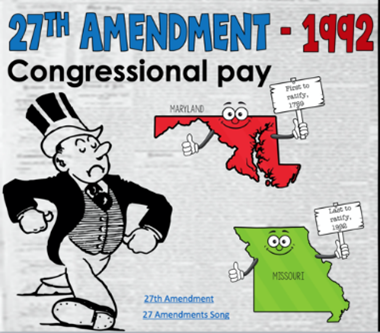
That was a disappointing year for Watson’s quest. North Dakota was the only state to ratify the Amendment that year, but the next year made up for it. Watson and his supporters were in sight of their goal. On May 5th, 1992 Alabama and Missouri passed the Amendment. New Jersey and Michigan both tried to score the winning touchdown, so to speak. Michigan won. Watson listened over the phone as his quest finally ended after ten long years or after two hundred-three years depending on your point of view. “I did treat myself to a nice dinner at an expensive restaurant.” Watson reminisced. He went on to say, “I wanted to demonstrate that one extremely dedicated, extremely vocal energetic person could push this through.”
After proving his point with a decade of grueling, often frustrating work, Watson got the grade he deserved. Zach Elkins, a different government professor at UT – Austin, was fascinated by Watson’s campaign. He approached Sharon Waite, who had left academia. Elkins told Waite about Watson’s successful efforts, and she agreed to change his grade to an A since UT-Watson did not allow A+ grades. The Texas state legislature passed a resolution congratulating Watson on his grade and his commitment to the political process.
Questions were raised about the validity of ratifying such an old amendment. In a case called Colman v. Miller (1939) the Supreme Court decided that since the Constitution did not specify a time limit on proposed amendments, an unratified amendment was still viable. The Court said that Congress would have to impose a time limit on a proposed amendment or the amendment would hang in limbo. Congress did impose time limits on later proposed amendments like the Equal Rights Amendment, but the 27th Amendment was free of that extra burden. However, just to cover all the bases, Congress passed a concurrent resolution affirming the ratification of the amendment. The House vote was 414-3 while the Senate vote was unanimous with one senator not voting. I couldn’t find out who didn’t vote and why, maybe he was sick that day.

The Twenty-seventh Amendment puts control of how public servants are paid back in the hands of the people. Of course, there are still dishonorable men and women who are more focused on getting rich than serving the people. There will always be such people. It is up to their constituents to vote them out. While we can’t do much about covert stock deals and bribes for no-bid contracts yet, the Amendment that was left behind keeps Congressional pay within reasonable limits.
Sources:
Consumer Price Index accessed via Google AI.
NPR – https://www.npr.org/2017/05/05/526900818/the-bad-grade-that-changed-the-u-s-constitution
Ronald Reagan Presidential Library and Museum – https://www.reaganlibrary.gov/constitutional-amendments-amendment-27-financial-compensation-congress
https://en.wikipedia.org/wiki/Twenty-seventh_Amendment_to_the_United_States_Constitution#