
I got stopped in the school lobby by a student the other day. She asked if I could explain tariffs to her. She had heard some of the national drama going on about tariffs and she wanted to understand it better. I told her I could explain it to her in five minutes. I did and she went to her next class understanding a little better what all the shouting was about.
As she walked away, it occurred to me that perhaps other people might be fuzzy on exactly what tariffs are and how they work. So, I decided that tariffs would be the second entry in the Civics Lexicon, a series of entries covering common, but frequently misunderstood terms from history, government and politics. Tariffs are pretty straightforward, so this should be a short entry. There are basically two kinds of tariffs – Protective tariffs and Retaliatory tariffs. We’ll start with the protective ones.
Protective Tariffs
Imagine that you live in a country called Lyoness and you are shopping for a new rocking chair. There are two furniture stores in town. One store is run by Randal, and he buys his furniture from local craftsmen. His rocking chairs are $12 each. The other store is run by Ronald and Ronald buys his furniture from Eire, the country across the sea, and his rocking chairs are $10 each. Which one are you gonna buy? The cheaper one made in Eire, of course.
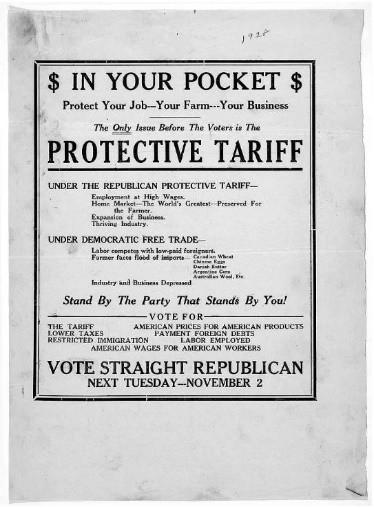
Now imagine that you are the Treasurer of Lyoness and you believe that your country would benefit from a thriving furniture industry. You want to get more citizens to buy Lyoness made furniture. One of the easiest ways to do that is to put a tariff on furniture made somewhere else. So, you put a $5 tariff on all furniture imported into the country.
Let’s change back to our first scenario. You are buying your rocking chair, but this time the protective tariff is in place. Ronald had to spend an extra $5 to get that rocking chair to his store. He needs to protect his profits, so he adds $5 to the cost of each rocking chair. Now his rocking chairs cost $15 each. Randal’s rocking chairs are still only $10 each. Which rocking chair are you going to buy now? Randal’s, right?
That’s how a protective tariff works. The people in charge add tariffs to imported goods to help local producers to thrive and build strong industries. Generally speaking, producers like these kinds of tariffs because they limit competition and consumers don’t like them because they make things more expensive.
Retaliatory Tariffs
There’s another kind of tariff – Retaliatory tariffs. Now imagine you are the head of the Lyoness. You are called the Head Lyon. The ruler of Eire, called the Supreme Snake, has really ticked you off. Maybe he invaded the little country of Avalon who is your ally. Or maybe his little sister ghosted your baby brother after they’d only been dating for like a week or something. Whatever the reason, you are REALLY MAD at the Supreme Snake of Eire. You want to hit him where it hurts – in his wallet. So, you slap a tariff on all goods imported from Eire. You’re furious. No one ghosts your baby brother! Not on your watch, darn it! You’re gonna make it a really high tariff. Let’s say $10. You slap an extra $10 on the price of everything built in Eire and sold in Lyoness. Consumers stop buying Eire made goods completely which is what you want. That will show them!
However, your citizens are now pissed at you, Head Lyon, because you made prices go up. The people over in Eire are now pissed, too. They’re mad at you AND their own Supreme Snake because their economy is tanking and people are being laid off. So eventually you and the Supreme Snake have to kiss and make up. Or to use political phrasing you hold a summit and resolve your differences. The Supreme Snake’s little sister agrees to go to prom with your little brother. The tariffs are repealed, and everyone lives happily ever after.
So that is what tariffs are and how they work. In theory, at least. How they work in real life depends on a lot of factors. I am not even going to begin to unpack that mess. You’ll have to read the news and figure it out on your own. If you do figure it out, please let me know because I, too, would really like to understand what all these idiots are doing.